7 things you might not know about Google My Business categories
I have found that Google My Business categories are often an overlooked tactic by many people that work in the Local Search space. According to Mozu2019s Local Search Ranking Factors Survey, proper Google My Business category associations are the #3 search ranking factor for local packs. It has been one of the top ranking factors for as long as I can remember so I wanted to share some things about Google My Business categories that people often arenu2019t aware of.
1. Google constantly changes the names of categories. For example, u201cLincoln Mercury Dealeru201d got renamed to u201cLincoln Dealeru201d in the fall of 2018 and u201cNatural Foods Storeu201d got renamed to u201cNatural Goods Storeu201d in December. Itu2019s important to know that Google can rename them so youu2019re not thinking itu2019s a new category that has been added.
2. Google constantly removes categories and adds new ones. For example, in the first six months of 2018 in the U.S., Google added 34 categories and removed 36. One that they added was u201cFitness Classu201d and one that they removed was u201cDog Sitter.u201d
3. New categories can give you a boost in ranking. In this thread, Rich Owings of Local Is Where Itu2019s At talks about how he started doing Local SEO for an escape room. Google had just recently added a category for this business type so most of the competition didnu2019t have the new category yet. By being one of the first to add the new category, he was able to move to the first page overnight.
4. Categories have different names in different countries. For example, in Canada Google My Business calls the Real Estate Agent category u201cEstate Agents.u201d This is likely because categories in Canada tend to be more similar to the way they are named in the UK. I can safely say as a Canadian that no one here calls real estate agents u201cestate agentsu201d but Google seems to think we do.
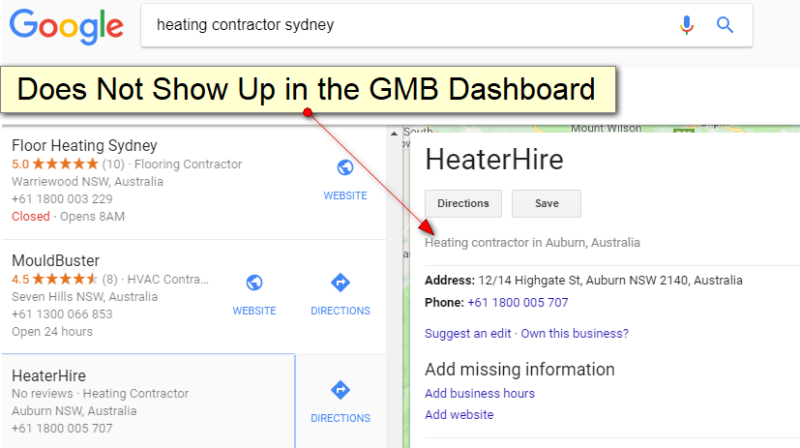
5. The categories you see on Google might not be the way they appear in the Google My Business dashboard. Every category has a GCID which does not change and a category name which varies based on the country. Iu2019ve found that sometimes Google displays the GCID in the search results which can be really confusing if youu2019re trying to figure out why your competitor is showing a category that you donu2019t u201cappearu201d to have as an option in the Google My Business dashboard. In this example, Brodie Clark asked on Twitter why u00a0he couldnu2019t find the Heating Contractor category to add to his client. This is because u201cHeating Contractoru201d is actually the GCID for the category thatu2019s named Central Heating Service in Australia.
 n
n
6. The concept of u201ccategory dilutionu201d is not true according to our testing. This concept states that you could u201cweakenu201d your ranking for a category if you have more than one category on your Google My Business listing. Instead of putting all your ranking power in one category, it would theoretically be dispersed amongst all the ones you pick. We have found the opposite to be true. Adding more categories often results in an increase in ranking and clicks because you now show up for more related queries. For example, we added the category u201cEmployment Attorneyu201d to a law firm in Florida when we noticed that they take a lot of employment-related cases. This is what happened to his ranking 48 hours later for local rankings for the query [employment lawyer cityname].
n n
n
7. The primary category holds more ranking power. I always suggest that a business pick their primary category wisely because it holds more ranking weight than secondary categories. The primary category is the first category you select in the Google My Business dashboard. We had a personal injury attorney who also practiced insurance law. He told us that his focus was personal injury so I suggested that we switch his categories around in Google My Business. Previously, he had u201cinsurance attorneyu201d as the primary category and u201cpersonal injury attorneyu201d as a secondary category. By reversing that, we saw an increase in most personal injury keywords and a decrease in the insurance attorney keywords.
n n
n
1. Google constantly changes the names of categories. For example, u201cLincoln Mercury Dealeru201d got renamed to u201cLincoln Dealeru201d in the fall of 2018 and u201cNatural Foods Storeu201d got renamed to u201cNatural Goods Storeu201d in December. Itu2019s important to know that Google can rename them so youu2019re not thinking itu2019s a new category that has been added.
2. Google constantly removes categories and adds new ones. For example, in the first six months of 2018 in the U.S., Google added 34 categories and removed 36. One that they added was u201cFitness Classu201d and one that they removed was u201cDog Sitter.u201d
3. New categories can give you a boost in ranking. In this thread, Rich Owings of Local Is Where Itu2019s At talks about how he started doing Local SEO for an escape room. Google had just recently added a category for this business type so most of the competition didnu2019t have the new category yet. By being one of the first to add the new category, he was able to move to the first page overnight.
4. Categories have different names in different countries. For example, in Canada Google My Business calls the Real Estate Agent category u201cEstate Agents.u201d This is likely because categories in Canada tend to be more similar to the way they are named in the UK. I can safely say as a Canadian that no one here calls real estate agents u201cestate agentsu201d but Google seems to think we do.
5. The categories you see on Google might not be the way they appear in the Google My Business dashboard. Every category has a GCID which does not change and a category name which varies based on the country. Iu2019ve found that sometimes Google displays the GCID in the search results which can be really confusing if youu2019re trying to figure out why your competitor is showing a category that you donu2019t u201cappearu201d to have as an option in the Google My Business dashboard. In this example, Brodie Clark asked on Twitter why u00a0he couldnu2019t find the Heating Contractor category to add to his client. This is because u201cHeating Contractoru201d is actually the GCID for the category thatu2019s named Central Heating Service in Australia.
n6. The concept of u201ccategory dilutionu201d is not true according to our testing. This concept states that you could u201cweakenu201d your ranking for a category if you have more than one category on your Google My Business listing. Instead of putting all your ranking power in one category, it would theoretically be dispersed amongst all the ones you pick. We have found the opposite to be true. Adding more categories often results in an increase in ranking and clicks because you now show up for more related queries. For example, we added the category u201cEmployment Attorneyu201d to a law firm in Florida when we noticed that they take a lot of employment-related cases. This is what happened to his ranking 48 hours later for local rankings for the query [employment lawyer cityname].
n
n7. The primary category holds more ranking power. I always suggest that a business pick their primary category wisely because it holds more ranking weight than secondary categories. The primary category is the first category you select in the Google My Business dashboard. We had a personal injury attorney who also practiced insurance law. He told us that his focus was personal injury so I suggested that we switch his categories around in Google My Business. Previously, he had u201cinsurance attorneyu201d as the primary category and u201cpersonal injury attorneyu201d as a secondary category. By reversing that, we saw an increase in most personal injury keywords and a decrease in the insurance attorney keywords.
n
n
Comments
Post a Comment